Build Your Sales Pipeline
How It Works
Start here to get tailored guidance by choosing a stage to see what to do next.
Step 1: Select Funnel Stage
Step 2: Specify Your Situation
Step 3: Get Actionable Insights
Build Your Sales Pipeline: From Chaos to Clarity
If you’re handling sales, your pipeline probably lives across Gmail threads, Notion notes, Slack channels, LinkedIn Groups, and a spreadsheet called “Leads...” It works in the beginning, but it doesn’t scale, it’s hard to prioritize, and it makes it almost impossible to see what’s actually driving results.
A sales pipeline brings structure to your process. It helps you see who is interested in your product, where they are in their buying journey, and what action is needed to move each deal forward.
We walk you through building your first sales pipeline and help you shape it into a system that improves with every customer conversation.
What Is a Sales Pipeline—and Why It Matters
A sales pipeline gives you structured clarity across your customer journey. It helps you see:
- Who you are selling to
- What stage they are in
- What is blocking them right now
- What specific action moves them forward
- How many deals are progressing or stalling
The Full Funnel: TOFU, MOFU, BOFU
Founders hear TOFU, MOFU, and BOFU in marketing, but they apply directly to sales and the customer journey.
- Top of Funnel (TOFU) awareness and prospecting. You are finding and contacting leads.
- Middle of Funnel (MOFU) discovery, qualification, and proposals. You are actively selling.
- Bottom of Funnel (BOFU) negotiation and closing. Deals are either moving forward or falling apart.
Each stage demands different messaging, energy, and actions. When aligned with the customer journey, the funnel becomes clearer:
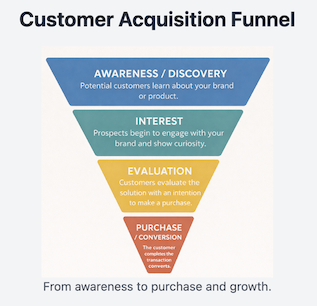
- Discovery people are not finding you or do not understand the problem you solve.
- Interest people are engaging but not going deeper or returning.
- Evaluation people are comparing options and need proof, clarity, and confidence.
- Conversion people want to buy but friction is blocking them.
- Growth and retention people bought but are not activating, staying, or sharing.
The funnel is not just about moving deals. It is about identifying exactly what is breaking at each stage and fixing that specific problem.
A simple guided flow that turns feedback into action
Instead of collecting more feedback, start by running your product through a short, structured check.
- Select the stage. Pick where you think you are stuck right now in the journey.
- Describe your situation. Choose the option that matches what you are seeing, like low discovery, low trust, unclear positioning, weak conversion.
- Get actionable output in three parts. Curated articles, AI search, and integrated growth tools.
Curated articles
A small set of hand picked reading that matches your exact stage and problem, so you are not starting from generic advice.
AI search
AI uses the curated set as context, finds more content on the same topic and quality level, filters noise, ranks what matters, and gives you a tight summary of shared insights and next steps so you can act without reading twenty tabs.
Integrated growth tools
You input your product or website URL and get implementable suggestions in one place, including SEO recommendations you can apply, competitor positioning insights you can use, product and marketing docs you can generate fast, and simple video assets that support visibility and trust.
Building a sales pipeline from scratch starts with identifying prospects at the top of funnel. Before you can build a pipeline, you need leads, so begin with a clear Ideal Customer Profile (ICP) and define who you are targeting. Keep your lead list organized from day one, track where each lead came from, and make it easy to follow up consistently. An action tip that works is committing to add 10 new leads per day to your TOFU list. Next, define your pipeline stages so they reflect how you sell and how your buyer buys. Most founders follow the same progression from curiosity to commitment. Start with prospecting: identify a potential lead through outbound research, an introduction, or inbound interest, then get them into your system, tag their source, and keep it simple. Block weekly time just for prospecting, because founders who stop prospecting usually stop selling soon after.
Why this works
- It makes feedback measurable because it maps to a stage.
- It makes feedback believable because it is tied to what users are doing right now.
- It makes feedback actionable because it ends with a clear next step you can implement immediately.
If you are dealing with lots of data but no direction, try framing your current problem inside the customer journey first, then run your product through a guided flow that produces concrete next actions.